

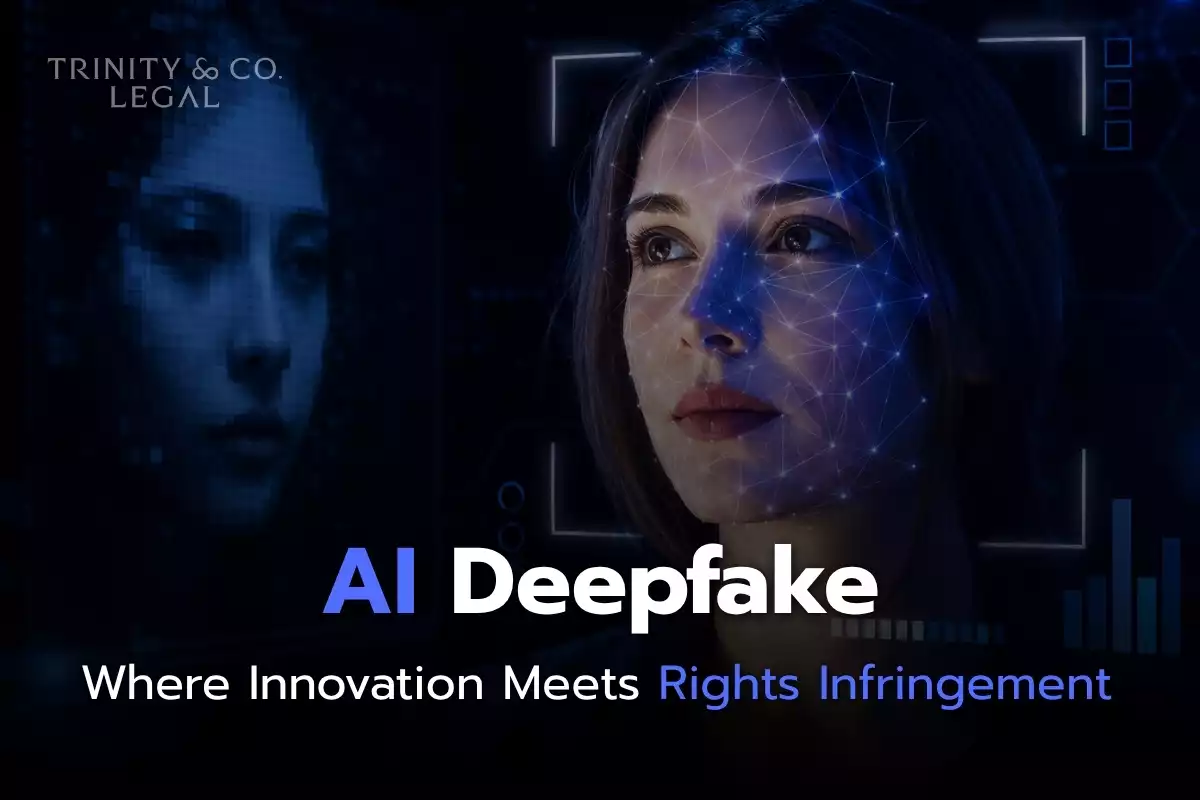
Artificial Intelligence (“AI”) has become deeply embedded in nearly every aspect of modern society, transforming industries ranging from business and healthcare to education, media, and entertainment. Among the most significant technological developments in recent years is the emergence of Deepfake technology, which utilizes advanced machine learning and deep learning algorithms to analyze and replicate a person’s image, voice, facial expressions, and mannerisms with remarkable accuracy.
Deepfake technology enables the creation of highly realistic digital content that can convincingly depict individuals saying or doing things that never actually occurred. To the average observer, distinguishing AI-generated content from authentic material is becoming increasingly difficult.
Initially, Deepfake technology was developed for legitimate and innovative purposes, including film production, digital content creation, historical restoration projects, educational tools, and virtual character development. However, as AI tools have become more sophisticated, accessible, and affordable, the potential for misuse has expanded significantly.
Today, Deepfakes are frequently used to create fabricated images, videos, and audio recordings without the consent of the individuals concerned. Examples include the creation of non-consensual explicit content, manipulation of public figures into fictitious situations, impersonation of corporate executives for fraud schemes, and dissemination of misleading political or commercial information. Such activities can severely damage an individual’s reputation, dignity, privacy, and economic interests, while simultaneously undermining public trust in digital information.
The concern surrounding Deepfakes extends beyond the mere creation of false information. The greater danger lies in their ability to create credibility for falsehoods. Historically, photographs and video recordings have been regarded as persuasive evidence of factual events. In the AI era, however, that assumption is increasingly unreliable. A fabricated video disseminated online for only a few minutes may cause irreversible reputational and commercial damage before its authenticity can be challenged.
From a legal perspective, the issue is no longer confined to technological innovation or ethical concerns. It raises fundamental questions regarding the protection of individual rights and the legal accountability of those who create, distribute, or facilitate the dissemination of Deepfake content.
A key legal question therefore arises: If an individual’s image, voice, or personal information is used to generate Deepfake content without authorization, particularly where such content causes reputational harm, public ridicule, social hostility, or commercial losses, what legal liabilities may arise under Thai law?
While Thailand currently does not have legislation specifically addressing Deepfakes, various existing laws may apply, including the Computer Crime Act, the Penal Code, the Civil and Commercial Code, and the Personal Data Protection Act B.E. 2562 (2019) (“PDPA”). The scope of liability will depend on the nature of the conduct, the intent of the actor, the resulting harm, and the factual circumstances of each case.
Understanding Deepfake Technology
Deepfake refers to AI-generated content created through machine learning and deep learning technologies that analyze digital information such as photographs, voice recordings, videos, and biometric data in order to generate new content that appears authentic.
The term “Deepfake” combines the concepts of “Deep Learning” and “Fake”, reflecting the technology’s capacity to generate fabricated content that closely resembles reality.
Unlike traditional photo or video editing, which often requires specialized expertise and substantial time, modern AI systems can learn a person’s facial features, voice patterns, expressions, gestures, and speech characteristics from publicly available online content and generate realistic simulations within minutes.
Common examples include:
- Face-swapping in videos;
- AI-generated voice cloning;
- Fabricated photographs depicting events that never occurred;
- Synthetic videos showing individuals making statements they never made;
- Creation of entirely fictional digital personas.
Beyond simple manipulation, Deepfake technology is capable of generating virtual news presenters, synthetic spokespersons, and entirely fabricated conversations involving real individuals. Consequently, images, videos, and audio recordings can no longer be presumed to represent objective reality.
Although Deepfakes have legitimate applications in entertainment, education, historical preservation, and communications technology, their misuse increasingly presents serious legal and societal concerns, particularly in relation to misinformation, identity fraud, financial scams, political manipulation, and privacy violations.
The legal risks associated with Deepfakes therefore stem not merely from their falsity, but from the harm they may cause to individuals, businesses, and society.
Liability under the Computer Crime Act
Although Thailand’s Computer Crime Act B.E. 2550 (2007) was enacted before the widespread adoption of Deepfake technology, several provisions remain applicable to AI-generated fraudulent content.
Because Deepfakes are typically created, uploaded, and disseminated through computer systems and online platforms, the relevant conduct may trigger liability under the Computer Crime Act in addition to civil and criminal laws.
Section 14: Inputting False Computer Data
Section 14 criminalizes the introduction of false computer data into a computer system where such conduct is likely to cause damage to the public.
In the context of Deepfakes, liability may arise where fabricated videos, images, or audio recordings are disseminated in a manner capable of misleading the public concerning significant factual matters.
Examples may include:
- Fabricated government announcements;
- Fake emergency alerts;
- Deepfake videos depicting public officials engaging in criminal conduct;
- False statements attributed to corporate executives affecting investor confidence;
- Fabricated content capable of causing public panic or economic disruption.
However, Thai courts have consistently emphasized that Section 14 is intended to protect public interests rather than serve as a substitute for ordinary defamation claims. Consequently, purely private disputes may not satisfy the statutory threshold unless broader public harm can be demonstrated.
Section 16: Altered Images Causing Damage to Others
Section 16 is arguably the provision most directly relevant to Deepfakes.
The provision prohibits the dissemination of images that have been created, modified, altered, or manipulated in a manner likely to cause another person to suffer reputational damage, humiliation, hatred, or public contempt.
Importantly, the wording of Section 16 is sufficiently broad to encompass AI-generated content. The law does not distinguish between traditional editing techniques and modern AI-based image generation.
Accordingly, where an individual’s image is used as source material for Deepfake content that is subsequently disseminated and causes reputational harm, criminal liability may arise.
Common examples include:
- Deepfake pornography;
- Fabricated videos portraying corruption or criminal activity;
- False content targeting business competitors;
- AI-generated recordings depicting individuals making offensive or unethical statements.
Liability may not be limited to the original creator. Individuals involved in uploading, distributing, or knowingly facilitating dissemination of such content may also face legal consequences.
Criminal Liability under the Thai Penal Code
Apart from the Computer Crime Act, Deepfake-related conduct may constitute criminal defamation under the Thai Penal Code.
Section 326: Defamation
Under Section 326:
“Whoever imputes anything to another person before a third person in a manner likely to impair the reputation of such person or expose such person to hatred or scorn commits defamation.”
The essence of defamation lies in communicating information concerning another person to a third party in a manner capable of damaging that person’s reputation.
Deepfake content can readily satisfy this requirement when it portrays an individual engaging in conduct that never occurred.
Examples include:
- A fabricated video showing a businessman bribing public officials;
- A synthetic recording suggesting corporate misconduct;
- A manipulated video portraying a public figure engaging in unlawful or immoral behavior.
Although Deepfake creators may argue that the content was intended as satire, parody, experimentation, or entertainment, such defenses may not succeed where actual reputational harm is foreseeable.
Indeed, Deepfakes often cause greater damage than traditional defamatory statements because visual and audio content tends to be perceived as more credible than text alone.
Section 328: Defamation by Publication
Where Deepfake content is disseminated through social media platforms such as Facebook, Instagram, TikTok, X (formerly Twitter), YouTube, or other publicly accessible channels, the conduct may constitute defamation by publication under Section 328, which carries more severe penalties.
Given the viral nature of digital media, a single Deepfake video may reach millions of viewers within hours, significantly amplifying the resulting damage.
Even after a Deepfake is exposed as false, reputational rehabilitation may be difficult or impossible. The resulting consequences may include loss of employment, cancellation of commercial contracts, diminished investor confidence, and broader social stigma.
Civil Liability
In addition to criminal sanctions, Deepfake creators and distributors may face civil liability under Thai tort law.
Pursuant to Section 420 of the Civil and Commercial Code:
“A person who, wilfully or negligently, unlawfully injures the life, body, health, liberty, property, or any right of another person is bound to make compensation therefor.”
Thai law recognizes that reputation, dignity, image, and personality rights constitute legally protected interests.
Accordingly, where Deepfake content causes reputational harm or infringes personal rights, affected individuals may seek compensation for damages.
Potential losses may include:
- Reputational damage;
- Loss of business opportunities;
- Loss of employment;
- Loss of advertising or endorsement contracts;
- Emotional distress and mental suffering;
- Costs associated with reputation management and legal enforcement.
For example, a Deepfake video falsely portraying a listed company’s CEO as engaging in corruption could lead to declining share prices, investor withdrawals, termination of commercial relationships, and reduced financing opportunities. Such economic losses may be recoverable in civil proceedings.
Similarly, artists, influencers, and public figures who lose sponsorships or commercial engagements due to Deepfake content may seek compensation for resulting financial harm.
Particularly serious cases, such as Deepfake pornography, may also support claims for damages arising from emotional distress, humiliation, anxiety, depression, and related psychological impacts.
Moreover, liability may extend beyond the original creator. Individuals who knowingly distribute or assist in spreading false content may, depending on the circumstances, be deemed joint tortfeasors.
PDPA Implications and Personal Data Rights
Deepfake technology also raises significant issues under Thailand’s Personal Data Protection Act B.E. 2562 (2019) (“PDPA”).
Photographs, facial images, voice recordings, identification information, and biometric data are generally considered personal data under the PDPA.
In many cases, the creation of Deepfake content requires the collection and processing of substantial amounts of personal information for AI training purposes or content generation.
Where such personal data is collected, used, disclosed, or processed without an appropriate legal basis or valid consent, the activity may constitute unlawful processing under the PDPA.
Examples include:
- Using social media photographs to train AI facial recognition systems;
- Cloning an individual’s voice without authorization;
- Using a person’s likeness in AI-generated advertising campaigns;
- Creating commercial content based on an individual’s image without consent.
Certain biometric information may also qualify as sensitive personal data or, at minimum, highly identifiable personal data warranting enhanced protection.
The legal risks become even more significant where Deepfakes are used for commercial purposes such as marketing, advertising, influencer campaigns, or revenue-generating content.
Such conduct may infringe not only data protection rights but also broader personality rights recognized under Thai law.
Furthermore, data subjects possess various rights under the PDPA, including the rights to access, object to processing, request deletion, and seek compensation for unlawful processing.
Organizations developing or deploying AI technologies should therefore establish robust governance frameworks to ensure compliance with applicable data protection requirements.
Challenges for Thai Law in the AI Era
Although existing Thai laws provide several avenues for addressing Deepfake-related misconduct, these legal frameworks were developed before the emergence of modern generative AI technologies.
Deepfakes exemplify a broader challenge confronting legal systems worldwide: technological innovation is advancing faster than regulatory adaptation.
Practical enforcement challenges include:
- Identifying anonymous creators;
- Cross-border jurisdictional issues;
- Foreign-based AI operators;
- Platform liability;
- Responsibility of AI developers;
- Allocation of liability among users, developers, and service providers.
Internationally, regulators have begun adopting more AI-specific measures, including mandatory disclosure requirements for AI-generated content, transparency obligations for AI systems, and enhanced penalties for malicious Deepfake activities affecting elections, public trust, or national security.
Thailand has likewise begun exploring AI governance initiatives. Nevertheless, important questions remain regarding whether existing laws adequately address emerging AI risks and whether dedicated AI legislation may eventually become necessary.
Future regulatory developments will likely need to balance two competing objectives: fostering technological innovation while protecting fundamental rights and public interests.
Conclusion
Deepfake technology has evolved from a creative and experimental tool into a powerful technology capable of significantly affecting individuals, businesses, and society.
While AI-generated content offers remarkable opportunities for innovation, it also presents substantial risks to personal rights, reputation, privacy, and public trust.
Under Thai law, even in the absence of Deepfake-specific legislation, individuals who create, distribute, or facilitate harmful Deepfake content may face multiple forms of liability simultaneously, including criminal liability under the Computer Crime Act and Penal Code, civil liability for tortious conduct, and regulatory exposure under the PDPA.
For businesses and organizations, the risks extend beyond becoming victims of Deepfakes. They also include potential liability arising from the deployment of AI technologies without adequate legal compliance, data governance, and ethical safeguards.
As AI-generated content becomes increasingly indistinguishable from reality, responsible AI use is no longer merely an ethical consideration—it is a legal imperative. A Deepfake created or shared within minutes can result in significant reputational damage, substantial financial losses, and serious legal consequences.
The challenge for policymakers, regulators, businesses, and society will be to ensure that the legal framework evolves alongside technological advancement, enabling the benefits of AI to be realized while safeguarding individual rights and maintaining public trust in the digital age.
Disclaimer
This article is provided for general informational purposes only and does not constitute legal advice. Specific legal advice should be obtained based on the facts and circumstances of each individual case.
By Pinprapus Chartikavanich
15 June 2026