

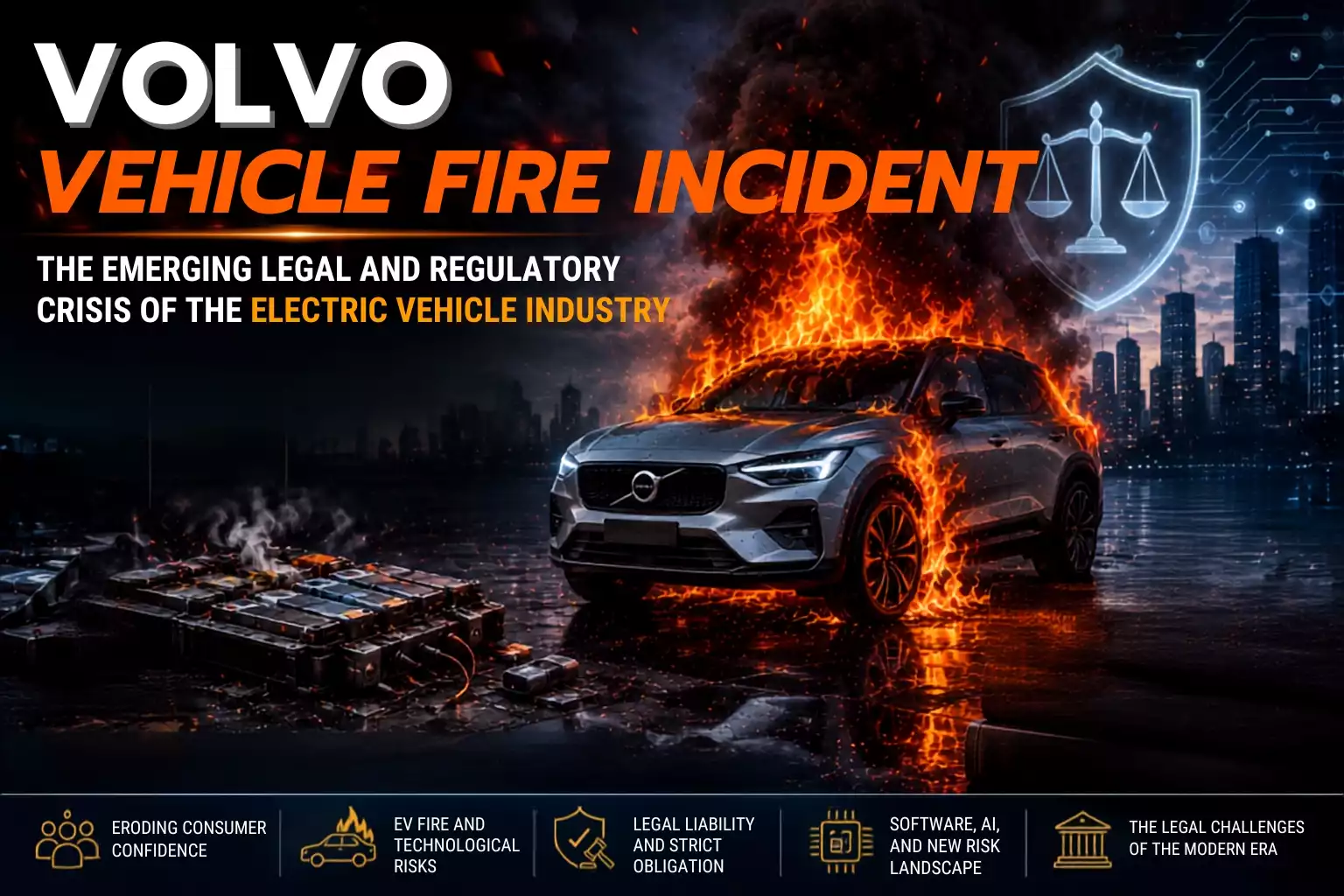
The recent vehicle fire incident involving an electric vehicle manufactured by Volvo Cars has attracted significant public attention and generated broader concerns extending far beyond the scope of an ordinary automotive accident. The incident reflects a fundamental shift in the global automotive industry, which is rapidly transitioning from traditional internal combustion engine vehicles toward a new era driven by electrification, battery systems, artificial intelligence, and software-integrated mobility technologies.
Over the past decade, electric vehicles (“EVs”) have been promoted globally as the future of transportation. Governments, regulators, and manufacturers have consistently emphasized the environmental advantages of EV adoption, particularly in relation to carbon emission reduction, sustainability initiatives, and the global transition toward clean energy policies. Numerous jurisdictions, including Thailand, have introduced aggressive investment incentives, tax privileges, and industrial promotion measures to accelerate EV adoption and establish themselves as regional manufacturing hubs.
However, as the EV industry expands at an unprecedented pace, a new category of legal and technological risks has emerged with increasing visibility — most notably, the risks associated with lithium-ion battery systems, which constitute the core component of virtually all modern electric vehicles.
What makes EV fire incidents particularly concerning is the inherent contradiction between public perception and technological reality. EVs are generally marketed as advanced, intelligent, and highly safe transportation systems. This perception is even more pronounced in the case of Volvo, a manufacturer historically associated with world-renowned safety standards and occupant protection engineering.
Accordingly, when a fire incident occurs involving a Volvo EV, the issue immediately transcends ordinary product malfunction concerns. The key questions become whether the safety systems functioned as intended, whether the manufacturer adequately anticipated foreseeable risks, and ultimately, whether the vehicle satisfied the legal safety standards reasonably expected by consumers.
From an engineering perspective, lithium-ion batteries possess characteristics fundamentally different from conventional fuel systems. These batteries store an extremely high density of energy within compact modules. Consequently, if the battery cells are subjected to physical damage, thermal stress, manufacturing defects, software malfunctions, overcharging, moisture intrusion, or electrical short circuits, the system may enter a condition known as “thermal runaway.”
Thermal runaway refers to a chain reaction in which overheating within one battery cell rapidly propagates to adjacent cells, resulting in uncontrollable temperature escalation, combustion, and in severe cases, explosions. Unlike conventional gasoline fires, lithium-ion battery fires present unique technical challenges. Even after appearing extinguished, such fires may reignite hours or days later due to residual chemical reactions within damaged cells.
Moreover, EV battery fires may emit toxic gases, hazardous fumes, and extremely high temperatures, thereby creating substantial risks not only for drivers and passengers, but also for firefighters, first responders, nearby property owners, and the surrounding public.
In several jurisdictions, emergency response authorities have reported that extinguishing EV battery fires may require massive quantities of water and prolonged cooling procedures. In certain cases, damaged EVs must be submerged in water-filled containment units for extended periods in order to prevent reignition. These operational realities demonstrate that EV technology is imposing entirely new burdens upon public safety infrastructure and emergency response systems.
Nevertheless, the most significant implications of such incidents arise not from engineering concerns alone, but from the legal liabilities that may follow.
Under Thai law, consumers are protected under the Product Liability Act B.E. 2551 (2008), which adopts the principle of strict liability. Under this framework, an injured party is not required to prove negligence or intent on the part of the manufacturer. Instead, liability may arise merely upon demonstrating that the product was “unsafe” and caused damage.
Importantly, the concept of an “unsafe product” extends beyond products that are defective in the traditional sense. A product may be considered unsafe if it presents risks exceeding the level reasonably expected by ordinary consumers under normal usage conditions.
Accordingly, if an EV catches fire during ordinary or foreseeable use, questions may arise as to whether the battery system, thermal management system, charging architecture, software controls, or safety warnings were adequately designed and implemented.
Potential liability exposure may extend to manufacturers, importers, distributors, software developers, component suppliers, and in certain circumstances, charging infrastructure operators.
Furthermore, EV-related liability is particularly complex because modern electric vehicles are no longer merely mechanical products. They are increasingly software-driven platforms integrating AI systems, sensors, cloud connectivity, autonomous functions, and over-the-air software updates.
This creates an entirely new category of legal questions.
If a thermal event is ultimately linked to software malfunction, algorithmic failure, sensor miscalculation, or defective battery management systems (“BMS”), determining liability becomes substantially more complicated.
Can a manufacturer characterize such incidents as unavoidable accidents if the software architecture contributed to the failure?
To what extent should manufacturers be held responsible for software updates deployed remotely after the vehicle has already been sold?
Could cybersecurity vulnerabilities or unauthorized software interference trigger battery system instability?
These questions are rapidly becoming central issues in modern product liability law worldwide because conventional legal frameworks were originally developed for physical products, whereas modern EVs increasingly operate as dynamic software ecosystems capable of altering vehicle behavior after delivery to consumers.
Another significant legal issue concerns product recall obligations.
Once a manufacturer becomes aware of potential battery-related risks, overheating tendencies, software vulnerabilities, or design defects, the company may have legal and ethical obligations to promptly notify consumers, issue recalls, deploy corrective software patches, or implement emergency mitigation measures.
Failure to take appropriate remedial action despite prior knowledge of foreseeable risks may substantially aggravate liability exposure and reputational damage.
Globally, several major automotive manufacturers have previously faced regulatory investigations, mass recalls, class action litigation, and substantial financial losses arising from EV battery fire incidents. In some cases, manufacturers were forced to limit battery charging capacity through software updates in order to reduce overheating risks, despite the resulting impact on vehicle performance and customer satisfaction.
These developments demonstrate that even leading global manufacturers have not yet fully resolved the inherent technological and safety challenges associated with high-capacity EV battery systems.
For Thailand, the rapid expansion of the EV sector has largely been driven by aggressive governmental promotion policies, including investment incentives provided by the Board of Investment, tax exemptions, and strategic industrial development programs aimed at positioning Thailand as a regional EV manufacturing center.
However, an increasingly important question is whether Thailand’s legal and regulatory infrastructure is adequately prepared to address the risks associated with widespread EV adoption.
At present, Thailand may still lack sufficiently comprehensive regulatory standards governing battery disposal, damaged battery transportation, EV fire suppression protocols, battery storage safety, thermal incident investigations, and hazardous waste management associated with EV systems.
Moreover, if EV fires occur within condominiums, underground parking facilities, shopping centers, or commercial buildings, highly complex legal disputes may arise involving multiple stakeholders, including vehicle owners, insurers, manufacturers, charging station operators, property developers, juristic persons, and software service providers.
From an insurance perspective, EV-related risks are also reshaping underwriting practices and claims assessments. Because EV batteries represent a substantial proportion of the vehicle’s total value, insurers may classify vehicles as total losses even where external damage appears relatively limited.
Simultaneously, environmental concerns surrounding EV battery disposal continue to intensify. Although EVs are frequently promoted as environmentally friendly technologies, battery disposal and post-fire hazardous waste management remain significant unresolved challenges globally.
Ultimately, the Volvo vehicle fire incident should not be viewed merely as an isolated accident involving a particular automotive manufacturer. Rather, it represents a broader reflection of the systemic legal, technological, and regulatory challenges confronting the global EV industry.
The world is rapidly advancing toward an era dominated by electrification, AI-driven mobility, and software-based transportation systems. Yet legal systems, regulatory frameworks, safety standards, and liability doctrines may still be evolving too slowly to keep pace with technological innovation.
In a world where vehicles increasingly function not merely as mechanical transportation devices, but as interconnected technological platforms powered by batteries, software, and data, EV fire incidents may no longer be regarded solely as engineering failures.
They are becoming one of the defining legal and regulatory risks of the modern automotive era.