

Furthermore, this article is not intended to accuse, assert, or conclude that any individual or juristic entity has committed any unlawful act whatsoever. Rather, it merely presents certain legal observations and perspectives relating to trademark law, trade dress, and the protection of branding and intellectual property rights, which have increasingly become subjects of academic and commercial interest. All opinions expressed herein are general legal analyses only and do not constitute legal conclusions or judicial determinations in relation to any particular dispute.
In today’s business environment, a “brand” is no longer merely a trade name or logo. Instead, it has evolved into a highly valuable economic asset composed of consumer perception, emotional association, commercial reputation, and the goodwill accumulated through decades of investment in marketing, design, and customer experience. This is especially true in the luxury sector, where the value of a business frequently lies not in the production cost of its products, but rather in its brand equity and perceived exclusivity.
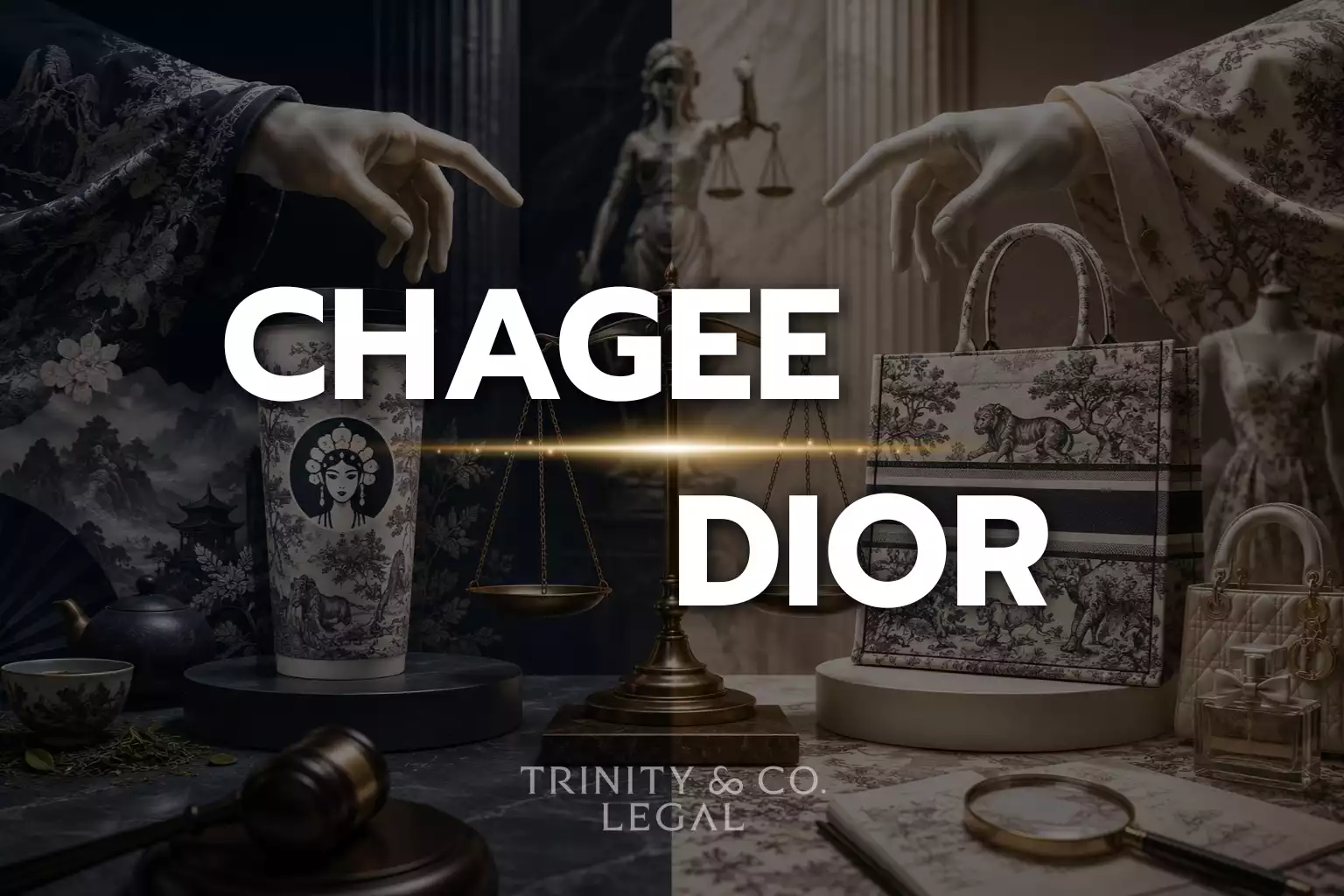
The controversy currently circulating across online platforms concerning CHAGEE and Dior therefore extends far beyond a mere discussion of ordinary design similarity. Rather, it serves as a compelling example of the evolving nature of intellectual property law in an era where the overall visual identity of a brand may itself constitute a protectable commercial asset.
Public criticism emerged after numerous consumers observed that certain packaging designs, advertising campaigns, color schemes, typography selections, and the overall aesthetic presentation associated with CHAGEE appeared strikingly similar to Dior’s established luxury branding style. Particular attention has been directed toward the use of monochrome luxury visuals, serif typography, minimalist elegance, and refined visual composition commonly associated with haute couture fashion houses.
From a legal perspective, drawing “inspiration” from existing design concepts is not inherently unlawful. The more significant legal question, however, concerns the point at which inspiration crosses into the unfair exploitation of another party’s commercial reputation. Equally important is whether such overall design presentation may create a “likelihood of confusion,” namely the possibility that members of the public could mistakenly believe that two brands are commercially connected, affiliated, endorsed, or otherwise associated with one another.
Historically, trademark protection focused primarily upon registered names, logos, or symbols. In modern legal systems, however, the scope of protection has expanded considerably to encompass what is commonly referred to as “trade dress,” namely the overall commercial appearance and visual identity of products or services. Trade dress may include packaging design, store layout, product arrangement, color schemes, decoration, and even the overall mood and tone associated with a brand.
Under United States law, the doctrine of trade dress protection is recognized under the Lanham Act. American courts have repeatedly affirmed that even where individual elements are not independently registered as trademarks, the overall presentation of a product or service may nonetheless receive legal protection if consumers associate that presentation with a particular source or business.
One prominent example is the landmark case of Two Pesos, Inc. v. Taco Cabana, Inc., in which the United States Supreme Court held that the interior décor and visual presentation of a restaurant could qualify for trade dress protection where such appearance possessed distinctiveness and functioned as a source identifier in the minds of consumers.
Accordingly, in the context of CHAGEE and Dior, the principal legal issue may not necessarily concern the direct use of the word “DIOR” itself. Rather, the more nuanced issue is whether the overall aesthetic presentation of CHAGEE evokes sufficient association with Dior in the perception of consumers, and whether such presentation could be viewed as capitalizing upon the prestige and commercial reputation traditionally associated with luxury branding.
Another particularly significant legal concept relevant to this discussion is “trademark dilution.” Unlike ordinary trademark infringement claims, which generally require proof of consumer confusion, dilution law is designed to protect the uniqueness, exclusivity, and distinctiveness of famous marks even in circumstances where consumers are not actually confused.
In other words, even where consumers fully understand that CHAGEE is not Dior, excessive similarity in aesthetic presentation may nonetheless diminish the distinctiveness and exclusivity historically associated with Dior’s luxury identity. Under certain legal systems, such conduct could potentially fall within the scope of dilution.
This principle is particularly important in the luxury industry because the value of luxury brands is fundamentally rooted in exclusivity and distinctiveness. If another business can successfully replicate the atmosphere, emotional appeal, or perceived social status associated with a luxury brand without independently investing in the development of its own heritage and goodwill, such conduct may directly affect the economic value of the original brand owner’s business.
Under Thai law, although the concept of trade dress has not yet been expressly codified to the same extent as in common law jurisdictions, the Trademark Act B.E. 2534 (1991), as amended, nevertheless provides a degree of protection for well-known marks.
Section 8(10) of the Trademark Act prohibits the registration of marks that are identical or similar to well-known trademarks in a manner likely to confuse the public regarding the ownership or origin of goods. In addition, Thai courts have increasingly recognized principles analogous to “passing off” and broader concepts of commercial good faith, aimed at preventing businesses from unfairly exploiting another party’s reputation or goodwill for commercial benefit.
Beyond trademark law, such issues may also intersect with the Trade Competition Act B.E. 2560 (2017), particularly where business conduct could be characterized as unfair commercial practice or as conduct likely to mislead consumers concerning goods or services.
Nevertheless, parties accused of imitation often raise an equally significant counterargument: namely that certain styles, aesthetics, or design concepts should not become monopolized by any single commercial entity. Elements such as monochrome color schemes, serif typography, or minimalist luxury presentation may arguably constitute common industry design language widely used throughout the fashion and lifestyle sectors.
This illustrates the delicate balance that intellectual property law must maintain between protecting proprietary rights on one hand, and preserving creative freedom and fair competition on the other. Excessively broad protection may allow dominant brands to monopolize general market aesthetics, whereas insufficient protection may permit unfair free-riding upon the commercial reputation of established businesses.
In practice, courts typically assess multiple factors collectively, including the degree of overall similarity, the reputation and fame of the original brand, the parties’ marketing behavior, the intention underlying the design choices, and the characteristics of the target consumers involved.
For luxury fashion houses such as Dior, whose commercial value is deeply intertwined with brand image and exclusivity, protecting visual identity is not merely a matter of prestige. It is fundamentally a matter of safeguarding substantial economic value accumulated over decades of brand development.
Conversely, the CHAGEE phenomenon also reflects a broader trend among modern Asian brands seeking to reposition themselves from mass-market beverage businesses into premium lifestyle brands through aesthetics associated with luxury culture. This strategy has become increasingly visible across China, Korea, and other parts of East Asia.
Ultimately, regardless of whether any actual legal dispute arises from this matter, one conclusion remains clear: the modern law of intellectual property has evolved dramatically. What receives legal and commercial protection today extends far beyond a mere brand name or logo. It now encompasses emotional identity, cultural imagery, consumer perception, and the intangible atmosphere brands create within the minds of the public.
And in an era where social media can transform a particular aesthetic into a global controversy within hours, the line separating “inspiration” from “infringement” has become thinner than ever before.
Disclaimer
This article is prepared solely for the purpose of providing general legal information and does not constitute legal advice. The information contained herein may not be exhaustive and may not reflect the most current state of the law. Readers should not rely upon this article as a substitute for legal advice from qualified legal professionals, who must assess the specific facts and circumstances of each individual case. The publication or use of this article does not create a lawyer-client relationship. All rights are reserved under the Copyright Act B.E. 2537 (1994).
Author: Pinprapus Chartikavanich
26 May 2026