

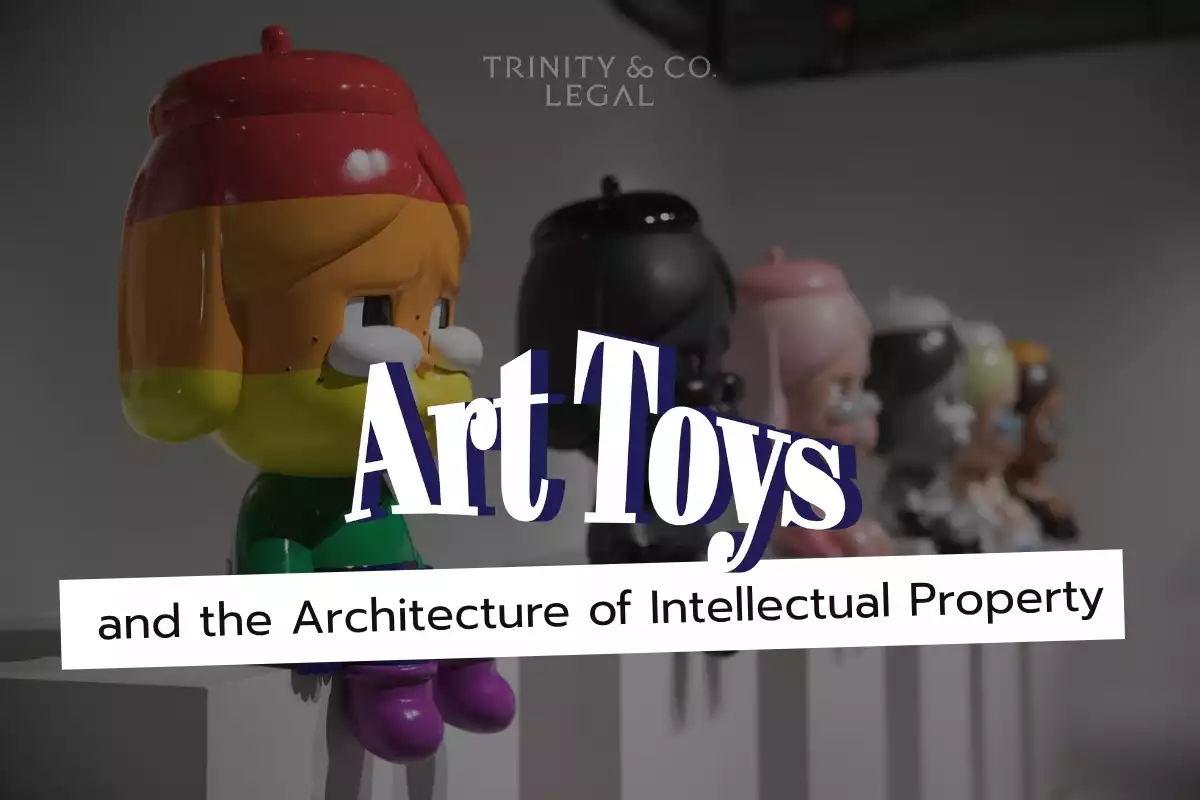
Over the past decade, Art Toys have undergone a fundamental transformation from niche collectible objects into commercially significant assets within the global creative economy. This evolution has repositioned intellectual property from a peripheral legal consideration to a central pillar of business strategy. In this context, intellectual property no longer functions merely as a protective mechanism but operates as a structural framework through which value is created, controlled, and ultimately monetized. The legal analysis of Art Toys must therefore extend beyond traditional doctrinal boundaries to encompass the intersection between creativity, commerce, and risk management in an increasingly globalized market environment.
Art Toys as Copyrightable Works
Under Thai law, the classification of an Art Toy as a copyrightable artistic work is determined not by its physical form alone, but by the underlying creative expression embodied within the work. Copyright protection attaches to the tangible manifestation of creativity, whether expressed through two-dimensional sketches or three-dimensional sculptural forms. In practice, the artistic nature of Art Toys arises from the integration of multiple creative elements, including distinctive character design, stylized proportions, carefully curated color palettes, and narrative-driven visual features. These elements, when combined, give rise to originality, which constitutes the foundational requirement for copyright protection.
It is essential to emphasize that originality in copyright law does not require absolute novelty in the sense applied under patent law. Rather, it requires that the work be independently created and reflect the author’s skill, labor, and judgment. Consequently, even works influenced by pre-existing artistic styles or popular culture may qualify for protection, provided that they exhibit sufficient individuality.
A particularly significant legal issue concerns the delineation between unprotectable ideas and protectable expressions. In the context of Art Toys, conceptual themes such as anthropomorphic animals or exaggerated body proportions fall within the realm of ideas, which remain freely accessible. However, the specific manner in which such concepts are expressed—through unique proportions, compositional arrangements, and aesthetic combinations—falls within the scope of copyright protection. Courts typically assess infringement by examining the overall impression of the work, applying a substantial similarity test that prioritizes the totality of the visual experience rather than isolated elements.
Furthermore, the dual nature of Art Toys as both artistic creations and industrial products introduces additional interpretative complexity. Nevertheless, under Thai law, the commercial production of a work does not negate its copyright protection, provided that it retains its artistic character. The determination of protection is inherently fact-specific and requires careful evaluation of both legal principles and artistic considerations. For this reason, the systematic documentation of the creative process plays a critical role in establishing ownership and originality in the event of disputes.
Trademarks and Industrial Design: Expanding the Scope of Protection
From a structural legal perspective, copyright protection alone is insufficient to capture the full commercial value of Art Toys. Instead, a broader framework of complementary rights must be considered. Trademark law, in particular, serves as a mechanism for transforming creative works into recognizable brand assets. In practice, trademarks may extend beyond conventional logos to include character names, distinctive visual identities, and even elements of trade dress, provided that they function as indicators of commercial origin. The commercial success of globally recognized Art Toy brands demonstrates that the value of such products is often rooted as much in brand identity as in the underlying artistic design.
At the same time, industrial design protection addresses a distinct but equally critical dimension of risk, namely the replication of product form at an industrial scale. Unlike copyright, which protects creative expression, industrial design rights focus on the visual appearance of a product as perceived by consumers. This includes shape, configuration, and structural composition. The relevance of this form of protection becomes particularly apparent in cases involving look-alike products, where minor modifications are introduced to avoid copyright infringement while preserving the overall visual impression. In such scenarios, industrial design rights provide a more objective basis for enforcement by focusing on the overall appearance of the product.
Taken together, these rights form a multi-layered protection structure in which each legal regime performs a distinct yet complementary function. Copyright safeguards the creative essence of the work, trademarks secure its commercial identity, and industrial design rights protect its physical manifestation within the marketplace. The integration of these rights allows for a more comprehensive and resilient approach to intellectual property management.
Ownership and Structural Risk
One of the most critical legal challenges in the Art Toy industry lies not in determining whether a work is protected, but in identifying who holds the rights. While copyright law generally vests ownership in the creator, this principle is frequently complicated by the collaborative nature of commercial production. In employment contexts, rights may vest in the employer, whereas in freelance arrangements, ownership typically remains with the creator unless explicitly transferred through written agreement.
A recurring source of dispute arises from the misconception that payment for services automatically results in ownership of intellectual property. In reality, copyright transfer requires clear and express agreement, often in written form. The absence of such clarity can lead to significant disputes, particularly in cases where artistic creation and commercial investment are undertaken by different parties.
In practice, disputes often reflect a misalignment between commercial expectations and legal realities. Artists may claim control over the use and development of their creations, while companies may assert rights based on financial investment and brand development. These tensions underscore the importance of carefully drafted agreements that clearly define ownership, usage rights, and revenue-sharing arrangements. Such agreements are not merely legal formalities but serve as essential instruments for managing risk and preserving long-term business value.
Commercial Exploitation and Strategic Structuring
In the contemporary market, Art Toys function as intellectual property platforms capable of generating value across multiple commercial channels. Licensing, collaboration, and brand extension are central mechanisms through which such value is realized. However, these mechanisms require careful legal structuring to ensure that the rights holder retains control over both the use of the intellectual property and the associated revenue streams.
Licensing agreements, in particular, must be approached as strategic instruments rather than simple permissions. Key considerations include territorial scope, duration, and permitted use, all of which must be aligned with broader business objectives. The structure of royalty arrangements also requires careful attention, including the definition of the revenue base, payment terms, and audit rights.
In collaborative arrangements, additional complexities arise in relation to trademark usage, quality control, and brand integrity. Failure to address these issues adequately may result in dilution of brand value and erosion of long-term commercial potential. Conversely, a well-structured intellectual property framework enables the rights holder to exercise effective control while maximizing opportunities for growth and expansion.
Infringement and Enforcement in a Borderless Market
The rapid expansion of the Art Toy market has been accompanied by a corresponding increase in infringement risks, which must be understood as structural rather than incidental. Infringement in this sector often takes the form of adaptive imitation, where infringers introduce minor variations to avoid direct copying while preserving the overall commercial appeal of the original work. This creates a legal grey area that complicates enforcement and increases the burden of proof on rights holders.
The rise of digital platforms and cross-border e-commerce has further transformed the nature of infringement, enabling the production, distribution, and sale of infringing goods across multiple jurisdictions. As a result, enforcement strategies must be designed with a global perspective in mind. Reactive approaches are no longer sufficient; instead, enforcement must be integrated into a broader strategic framework that includes monitoring, rights registration, and coordinated legal action.
Legal remedies range from cease-and-desist letters to civil and criminal proceedings, depending on the scale and nature of the infringement. Customs measures also play a critical role in intercepting infringing goods at the point of importation. However, the effectiveness of such measures depends on proactive engagement by rights holders, including the registration of rights and ongoing cooperation with enforcement authorities.
Conclusion
In the modern Art Toy industry, intellectual property protection cannot be reduced to a defensive exercise. Rather, it must be understood as a fundamental component of business architecture. As the market continues to evolve, the distinction between legal protection and commercial strategy becomes increasingly blurred. Intellectual property rights are no longer merely tools for preventing infringement; they are mechanisms through which value is structured, controlled, and sustained over time.
Accordingly, the question is no longer whether a particular work can be protected under the law, but how rights should be designed and deployed to support long-term business objectives. This requires a shift from a compliance-based mindset to a strategic approach that integrates legal, commercial, and operational considerations into a coherent framework. In this sense, the protection of Art Toys is not simply about preserving rights, but about constructing a durable foundation for sustainable growth in a competitive and rapidly changing global market.
Disclaimer: This article is prepared for general informational purposes only and does not constitute legal advice. Readers are advised to seek professional counsel for case-specific analysis. This publication does not create a lawyer–client relationship. All rights reserved under the Copyright Act B.E. 2537 (1994).
Author: Pinprapus Chartikavanich
Date: 27 April 2026