

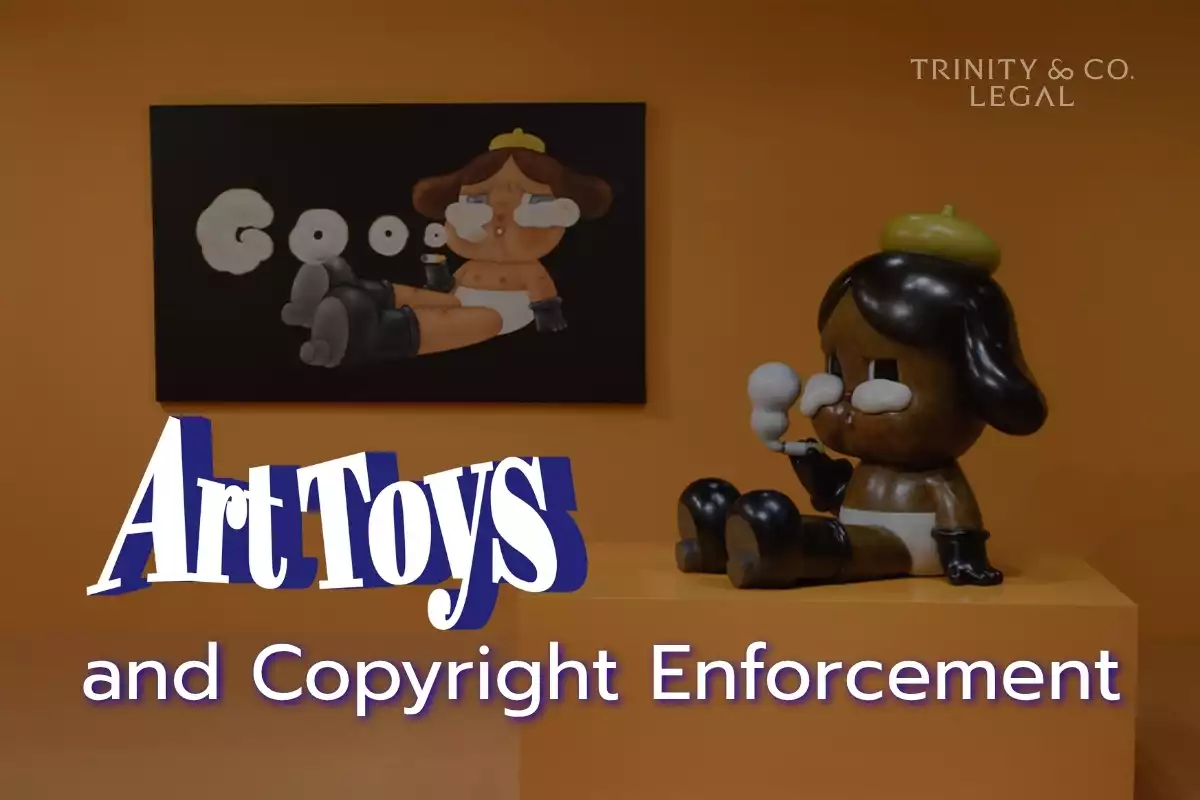
In recent years, the Art Toy market has experienced exponential growth, evolving both as a form of artistic expression and as a high-value intellectual property asset. However, such success is inherently accompanied by structural risks that are difficult to avoid—most notably, copyright infringement. This risk extends far beyond the mere production of counterfeit goods and encompasses unauthorized adaptations of characters, reproduction without consent, and commercial exploitation across digital platforms in multiple jurisdictions.
Within this context, litigation should not be viewed merely as a mechanism for dispute resolution, but rather as a strategic instrument that business operators must understand and deploy effectively.
In an industry where artistic value and commercial value are deeply intertwined, copyright infringement does not merely result in short-term revenue loss. Instead, it poses a threat to the very “architecture of rights” that underpins long-term business growth. Accordingly, litigation must be elevated beyond a remedial function and reconceptualized as a strategic enforcement tool operating across multiple dimensions.
First, litigation serves as a mechanism for market norm-setting. In markets where infringement can occur rapidly—particularly through digital platforms—the failure of rights holders to act may be interpreted as implied tolerance. This, in turn, facilitates widespread infringement. Conversely, consistent and systematic enforcement—even in cases involving relatively low damages—sends a clear policy signal that the rights holder is committed to protecting its rights, thereby generating a deterrent effect within the broader ecosystem.
Second, litigation functions as a means of preserving the value of intellectual property. In the case of Art Toys, value is often intrinsically linked to distinctiveness and scarcity. Unauthorized reproduction or adaptation diminishes these qualities, thereby eroding both market pricing and the potential for downstream commercialization, including licensing, collaborations, and expansion into other media.
Third, from a transactional perspective, a demonstrable enforcement track record constitutes a critical factor in building confidence among investors, business partners, and licensees. Investors assess not only the existence of intellectual property assets, but also the rights holder’s capability and willingness to protect them. Litigation thus operates as behavioral evidence reflecting the quality of rights management at the organizational level.
Fourth, litigation may be leveraged as a negotiation tool. In many instances, initiating enforcement through cease-and-desist letters followed by litigation may result in commercially advantageous outcomes beyond monetary damages. These may include converting infringers into business partners, entering into licensing agreements, or structuring settlements that allow for controlled future use of the rights.
Finally, in the context of cross-border infringement, litigation must be designed as a multi-jurisdictional strategy. This requires consideration of legal differences, procedural frameworks, and enforcement efficiency across jurisdictions. The selection of an appropriate forum, coordination with foreign counsel, and utilization of supplementary mechanisms such as platform takedowns or customs enforcement are all integral components of an effective enforcement strategy.
Legal Status of Art Toys Under Copyright Law
The distinction between “idea” and “expression” lies at the core of copyright analysis in the Art Toy industry and frequently gives rise to disputes in practice.
As a matter of principle, copyright law protects only the expression of an idea, not the idea itself in the abstract. General concepts—such as “cute animal characters” or “science fiction figurines”—remain freely usable, provided that they do not replicate the specific form of expression created by another.
However, in the context of Art Toys, the boundary between idea and expression is rarely clear-cut and must be assessed holistically. Courts typically evaluate the overall impression of the work, taking into account elements such as structure, proportions, form, line work, facial features, posture, color schemes, and artistic detailing. When these elements combine to create a distinctive character, the work may qualify for copyright protection.
In practice, courts assess whether the allegedly infringing work constitutes substantial reproduction or adaptation of the original, rather than focusing on isolated similarities. Even where minor elements—such as color or small details—are modified, infringement may still arise if the overall structure reflects the core expression of the original work.
Conversely, similarities confined to shared ideas or genre conventions—such as stylized proportions commonly found in Art Toys—will not constitute infringement, provided that the new work demonstrates meaningful differences in design.
For business operators, understanding this distinction is essential not only to avoid infringing third-party rights, but also to develop an effective rights protection strategy. This includes designing distinctive characters, maintaining records of the creative process, and clearly defining the commercial scope of rights to enable effective enforcement in future disputes.
Forms of Infringement in the Art Toy Industry
Infringement in the Art Toy industry exhibits unique characteristics that extend beyond direct copying. It has evolved into increasingly sophisticated forms driven by market dynamics and technological advancement.
While industrial-scale counterfeiting remains the most visible form of infringement, it presents significant enforcement challenges, particularly where production and distribution chains span multiple jurisdictions. Effective enforcement requires source tracing, evidence collection, and coordination with authorities such as customs agencies and e-commerce platforms.
More nuanced forms of infringement arise through so-called “inspired designs,” where infringers attempt to avoid direct similarity by modifying proportions, altering features, or changing color schemes. Despite the absence of literal similarity, such works may still infringe if they retain the distinctive identity of the original, raising complex issues of substantial similarity.
The expansion of digital markets has introduced additional layers of complexity. Unauthorized uses now include NFTs, in-game assets, and online merchandise, implicating multiple areas of law, including copyright, trademark, and electronic transactions.
The central challenge in such cases lies in establishing substantial similarity, which requires a holistic assessment rather than a mechanical comparison. Courts consider whether the allegedly infringing work captures the core expression of the original, often relying on expert testimony in art and design to distinguish between general inspiration and infringing adaptation.
Litigation Process: From Evidence Gathering to Judgment
Copyright litigation in the Art Toy industry is not merely procedural but inherently strategic, requiring advance planning, systematic evidence management, and risk assessment at each stage.
The process begins with establishing ownership, which may be complex where works involve multiple contributors, external designers, or subsequent rights transfers. Plaintiffs must demonstrate a complete chain of title from creation to present ownership.
Once ownership is established, the plaintiff must prove both access to the original work and substantial similarity. Evidence of access may include public dissemination, exhibition, or prior business relationships. Substantial similarity analysis requires detailed examination of artistic and structural elements, often supported by expert testimony.
Evidence plays a critical role, including both final works and process-based evidence such as drafts, design iterations, and development timelines. Sales data and distribution records are equally important in establishing the scope of infringement and quantifying damages.
Interim measures, such as injunctions or seizure orders, may be sought to prevent further harm, particularly where infringing goods are widely distributed. These measures also enhance negotiation leverage.
In assessing damages, courts may consider actual losses, infringer profits, or, in certain cases, punitive damages. Accordingly, well-structured financial evidence is crucial in determining outcomes.
Strategic Considerations in Litigation
Litigation strategy reflects the integration of legal and commercial considerations. Decisions regarding whether, where, and when to litigate have direct implications for market positioning, brand value, and stakeholder relationships.
In cross-border cases, forum selection is effectively the design of the competitive arena. Differences in legal standards, procedural mechanisms, and enforcement efficiency across jurisdictions necessitate careful strategic evaluation.
Litigation may also function as a commercial tool to generate system-wide deterrence. Even low-value cases may serve to signal rigorous enforcement, reinforcing brand credibility and investor confidence.
Furthermore, litigation can create leverage for settlement negotiations, potentially transforming disputes into collaborations through licensing or partnerships.
However, reputational risk must be carefully managed. Aggressive enforcement against smaller players may provoke backlash, particularly in communities driven by emotional attachment to brands. Balanced communication and principled enforcement are therefore essential.
From Rights Protection to Preventive Structural Design
Ultimately, litigation should not be viewed solely as a reactive measure but as part of a proactive, integrated business strategy.
Successful operators build a comprehensive IP ecosystem encompassing distinctive design, systematic evidence management, ongoing risk monitoring, and strategic use of legal tools.
The integration of law, marketing, and IP management is not merely theoretical but a determinative factor in long-term brand sustainability. Businesses that utilize legal mechanisms not only to resolve disputes but to create and protect value will achieve structural competitive advantages.
Conclusion
Copyright infringement in the Art Toy industry must be understood not as isolated disputes but as a systemic risk affecting market structure, competition, and consumer behavior.
Where creativity constitutes the core asset, unchecked infringement undermines brand value, market confidence, and long-term commercialization potential.
Accordingly, litigation should be embedded as a proactive component of business strategy, aligned with brand positioning, licensing policies, and enforcement standards.
Operators capable of transforming legal risk into strategic opportunity—through an integrated approach to intellectual property—will be best positioned to sustain competitive advantage in this creativity-driven industry.
Disclaimer
This article is prepared for general informational purposes only and does not constitute legal advice. Readers are advised to seek professional legal counsel prior to taking any action. All rights reserved under the Copyright Act B.E. 2537 (1994).
Author: Pinprapus Chartikavanich
30 April 2026